French mandate
Introduction to the French Mandate: Flows, Lifecycle, and E-Reporting
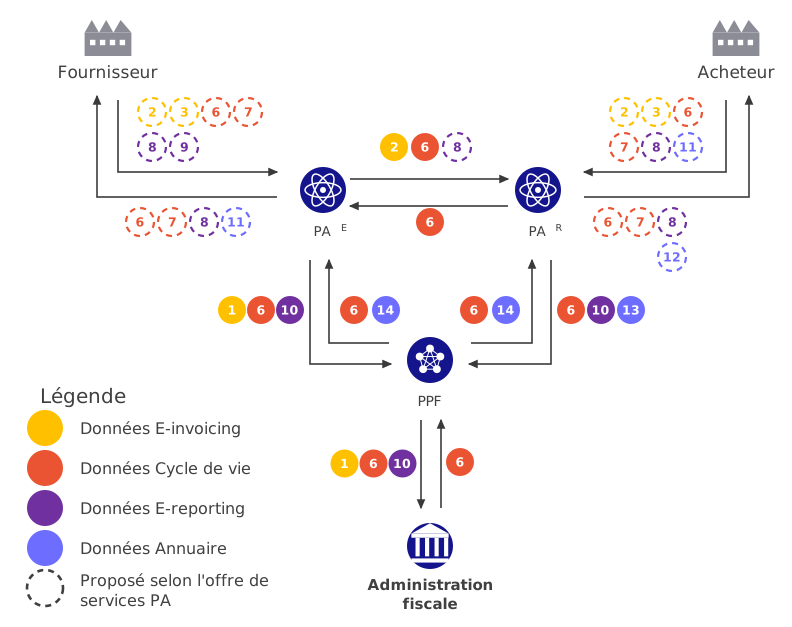
Electronic invoicing regulations in France introduce a cooperative architecture known as the 5-Corner Model. In this ecosystem, the exchange of documents and tax data never occurs directly or in isolation between a supplier and a customer. Instead, it must route through and be validated by government-certified platforms called PAs (Plateformes de Dématérialisation Partenaires or Accredited Platforms), which work alongside the central public portal (PPF - Portail Public de Facturation) and the tax authority (DGFIP).
The 5 Corners of the Flow
-
Corner 1 (Supplier): The issuing company that generates the invoice using its compatible software solution.
-
Corner 2 (Sending PA / PDPE): The supplier’s accredited platform (the role performed by A-Cube), responsible for receiving the document, validating it, extracting tax data for the government, and routing it to the recipient.
-
Corner 3 (Receiving PA / PDPR): The accredited platform chosen by the buyer, tasked with receiving the invoice from Corner 2, making it available to the customer, and managing its lifecycle statuses.
-
Corner 4 (Buyer): The receiving company that collects and records the invoice within its own management systems.
-
Corner 5 (PPF / DGFIP): The public portal and tax authority that centralize the directory (Annuaire), receive aggregated tax data, and monitor the entire lifecycle.
Core Mandate Flows (Summary)
To support this architecture, A-Cube automatically processes and dispatches data across three core regulatory compliance streams:
1. E-Invoicing (Real-Time Dual Transmission)
-
Application: Strictly mandatory for Domestic B2B transactions (VAT-registered companies established in France).
-
Mechanism: When an invoice is submitted, A-Cube executes a dual transmission in real-time: it routes the complete document (in UBL, CII, or Factur-X format) via the Peppol network to the buyer's PA (Corner 3), while simultaneously transmitting the mandatory tax data subset to the PPF (Corner 5).
2. Document Lifecycle & Statuses (Flow 6)
-
Application: Real-time tracking and synchronization of invoice states across all 4 business corners and the PPF.
-
Mechanism: Status updates are exchanged using standard structured XML CDAR messages. PAs automatically handle Technical Statuses (e.g., rejections), while users must report mandatory Business Statuses (such as commercial refusals) and Payment Statuses (required if operating under a VAT-due-on-payments regime).
3. E-Reporting (Periodic Tax Reporting)
-
Application: Applies to all commercial operations excluded from the standard e-invoicing mandate.
-
Mechanism: Instead of real-time invoice routing, transaction and payment data for International B2B, B2C sales, and cross-border operations must be aggregated and periodically transmitted to the PPF in a proprietary XML format. Transmission frequency (every 10 days, monthly, or bimonthly) is automatically determined based on the company's official VAT regime.